Smith, Stuart, and the Magic Sword
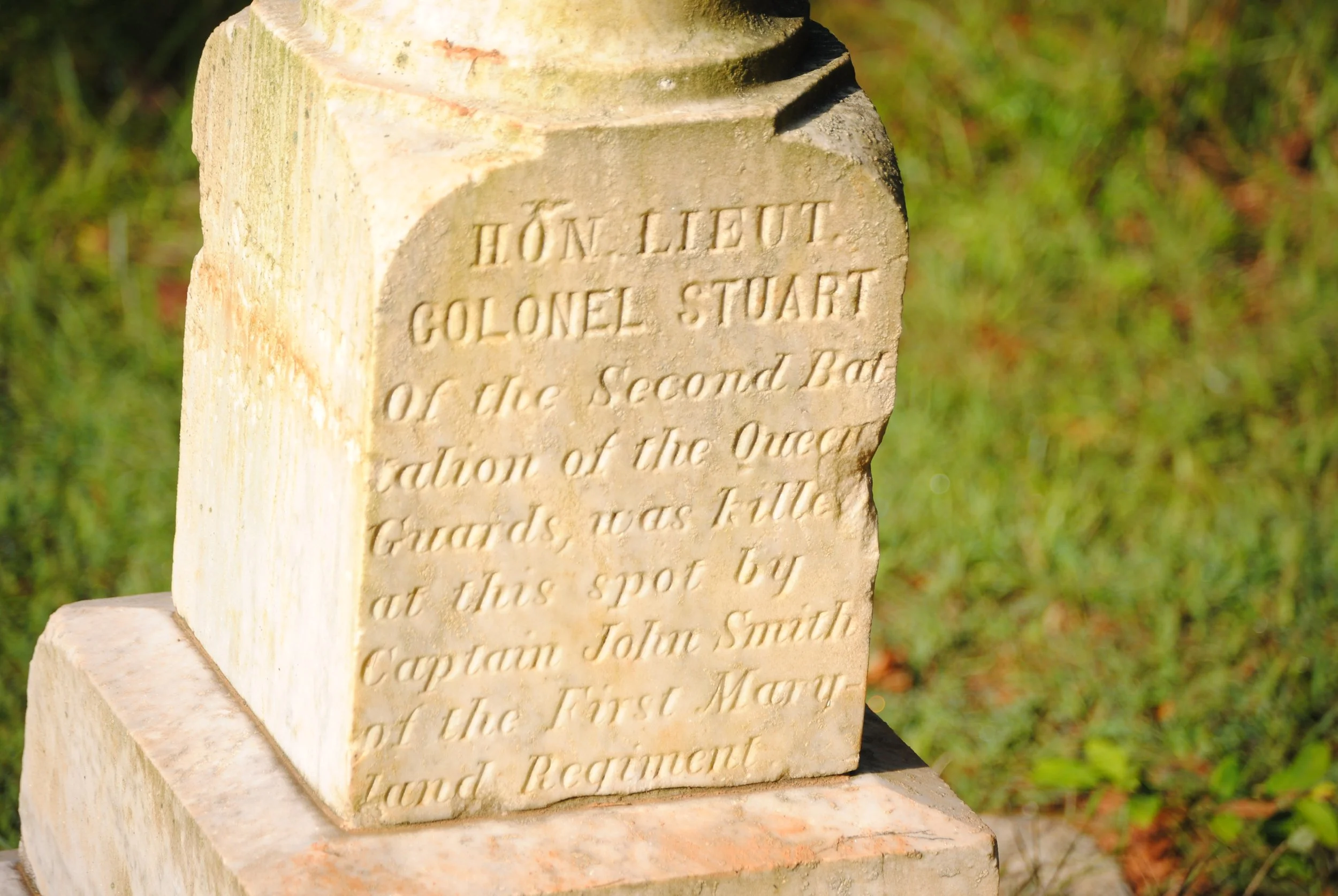
The Battle of Guilford Courthouse left many great stories in its wake. The best, and the most popular, was the story of the encounter between Lieutenant Colonel James Stuart of the 2nd battalion of the Guards, and Captain John Smith of the 1st Maryland Regiment. The legend of the battle holds that Stuart and Smith had met on the field of battle once before, and both had sworn that if they met again, blood would spill. This bit of folklore, fascinating as it is, is almost certainly fiction. The Guards arrived in the field of operations the day after the Battle of Cowpens, and there had been very little opportunity for a serious, personal encounter between Stuart and Smith before Guilford Courthouse.
As the legend goes, when Stuart and Smith spied each other, the events developed naturally, as if guided by the hand of Providence. The battle in their immediate area paused, and the opposing sides split like the Red Sea for Moses. The two paladins approached each other, and eschewing guns, bullets, and other trappings of modernity, mutually decided on the only possible way to resolve their conflict: a sword fight.
The situation begged for classical illusions. William Johnson, an early historian of the matter, saw ancient Greene and Rome in the air. He insisted the Guards and the 1st Maryland were the “Jovians and Herculeans of the two armies.” The story never lost its superhuman qualities. When the two warriors met, Stuart wielded a rapier, Smith a heavy saber. Smith, in the legend a chivalric hero, cleaved Smith in two in a single stroke. Johnson effused that the situation was pregnant with “all the features of chivalry and romance.” Indeed, if we believe the legend, he was right. Cleaving one’s enemy was a classic move for a chivalric hero, as was made evident in the Orlando Furioso, when Roland, the hero, cleaved the King of Friesland in two with a single stroke of his massive broadsword: “The tyrant shortly joined, he on the crest/ Smote at his head so well he cleft it through.”
The contemporary sources, less impressed, confirmed very little of the story. Tarleton got none of it right: “Colonel Washington’s dragoons [not true] killed Colonel Stewart [note the misspelling].” Lee came closer: “Stuart fell by the sword of Captain Smith.” True as far as it went, but lacking the supernatural allusions that made the legend so fascinating.
Ultimately, the story, at least, the story as told by Lee, was confirmed after the war by a man who had worked with Smith in business. But as interesting as the story was, it had an even more fascinating denouement. David Schenck wrote that in 1866, a sword was found at the traditional site of the Stuart-Smith encounter. He described it in glowing terms; it was “beautifully chased with a coat of arms and is of the finest steel.” The supernatural aspects of the story never left it; the sword had lain in the mud for eighty-five years and showed no corrosion. This was the stuff of romance, indeed.
Schenck immediately attributed the sword to Colonel Stuart. Thomas Taylor, in his 1983 paper, wrote of the sword. He noted that it was last noted in 1956, after which it disappeared from inventories of items found on the battlefield. What happened to it? Did it, as magical as the story itself, return to Olympus? I imagine the sword’s real fate, like the story itself, was more mundane. An opportunistic individual saw a chance, grabbed the sword and sold it, but who and where will never be known. All we have left is the legend, utterly fascinating in itself and as a lesson in how stories grow in the telling.